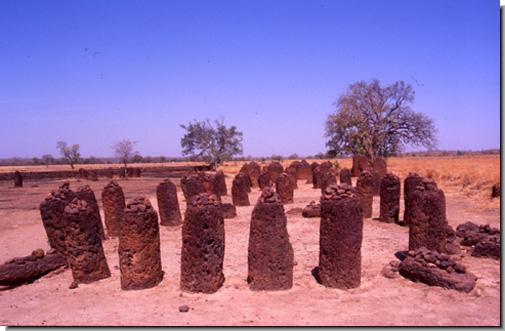
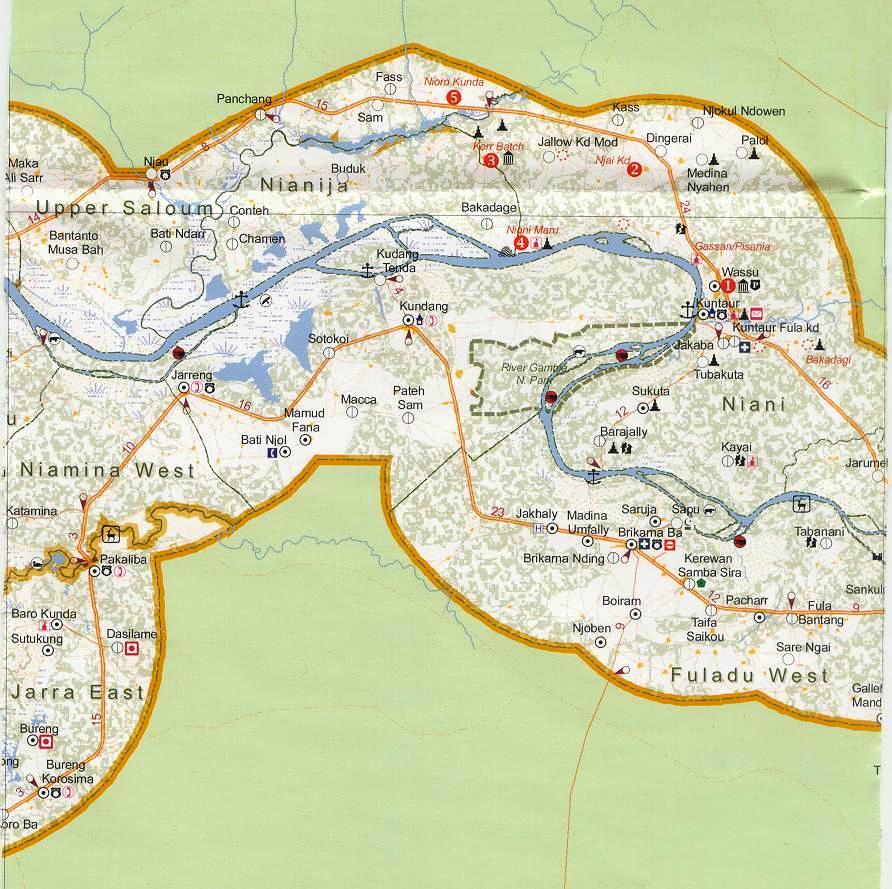
The ancient Wassu Stone Circles, in Gambia, are located around Wassu in the Central River
Region and are believed to be burial mounds of Kings and chiefs
in ancient times over 1,200 years old and has been dated to between
750-1000 AD, and because of this local legend has it that there
is a curse on anyone who disturbs those laid to rest there. This
may account as to why they have lasted so long with little human
interference.
in Gambia, are located around Wassu in the Central River
Region and are believed to be burial mounds of Kings and chiefs
in ancient times over 1,200 years old and has been dated to between
750-1000 AD, and because of this local legend has it that there
is a curse on anyone who disturbs those laid to rest there. This
may account as to why they have lasted so long with little human
interference.
The stones sizes and circular shapes do vary from 10 to 20 stones
with sizes from 4 to 6 metres across. Though they were burial
sites the stones themselves are of a younger age than the graves.
The average height of each stone column is 5 feet 9 inches. The
11 large concentration of circles have puzzled many a traveller
over the centuries and have been the subject of dozens of archaeological
excavations since the 1800s.
Excavations were made on them earlier this century but none came
closer to laying bare the whys and wherefores of the site than
the one carried out about over 30 years ago which revealed their
age. What has been found are iron weapons, arrow and spearheads,
knives, pottery vessels and bronze ornaments
The stones were cut out of laterite that occurs in large quarry
outcrops in this region and then shaped with iron tools into
cylindrical or polygonal shapes. A museum situated at the "Stone
Circles" in Wassu Central River Division was opened in 2000.
Hundreds of stone circles can be found in The
Gambia and Senegambia region. They are part of a geographical
grouping of over 1,000 monuments in a wide strip measuring 62
miles wide and along 217 miles of the Gambia
River.
This sacred site was declared a National Monument in 1995 and
on the 21st July, 2006, 93 monuments in the Senegambia region
(Sine Ngayène, Wanar) were declared by UNESCO
to be a World Heritage Site.
 Travel Information
This attraction is accessible through localised taxi
transport. Journey time is about 5 hours from Banjul.
You get off at Janjangbureh and
make your way up to the site. Admission is D50. You can't miss
the signpost deployed on the main road at Georgetown. This is
a town that still maintains its colonial bearing in buildings
and other things attributable to that period. Otherwise known
as Janjangbureh. Small and silent
as they are their very nature continue to puzzle even authorities
on the subject of ancient African history. If you are a fan of
Africa, its people and its history
prepare for variety and originality.
|
|
 Attractions

Nature
Reserves
Resorts
 Bakau Bakau
Banjul
Bijilo
Brufut
Cape
Point
Fajara
Gunjur
Jinack
Island
Kartong
Kololi
Kotu
Makasutu
Sanyang
Serrekunda
Tanji Village

|