Introduction:
 Up
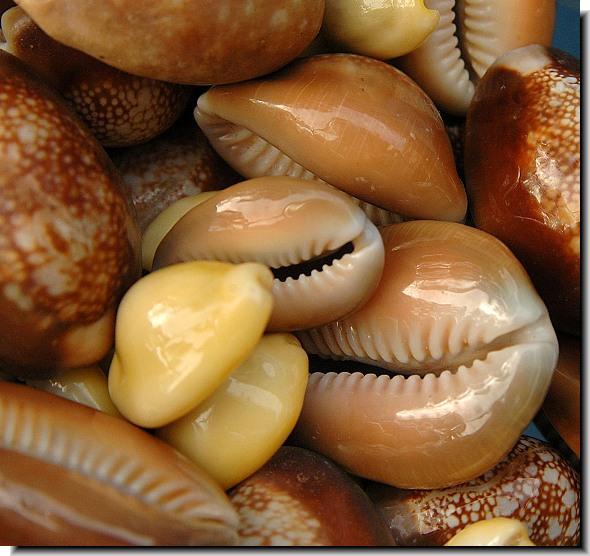
until the mid 19th century the accepted legal tender as a medium
of exchange in The Gambia was payment
using Cowrie Shells. The earliest forms of currency were 'coins'
made of copper or brass rods and sometimes metal tokens. Up
until the mid 19th century the accepted legal tender as a medium
of exchange in The Gambia was payment
using Cowrie Shells. The earliest forms of currency were 'coins'
made of copper or brass rods and sometimes metal tokens.
Early Legal Tender:
By 1880 coins made of silver, predominantly in the shape of French
5 Franc monetary units, were in widespread circulation. In 1892
the African Banking Corporation was established in Lagos, Nigeria,
and one of the Bank’s functions was to supply West African countries
with new British coins and remove old silver coins from the monetary
supply and send them back to the UK. In 1894 these functions were
given to the Bank of British West Africa.
Notes & Coins
In 1912 a committee was set up to examine possible ways of establishing
a more consistent currency and to establish policies for the future.
In 1915 the committee that had now become the West
African Currency Board, updated its established constitution
to allow it to issue bank notes. The proposal was put forward
that currency notes be issued to each West African colony but
that these should be "under the authority of the Currency
Board in London". The notes were to be the same design but
bearing the differentiating mark of each issuing office.
This
system stayed in place until 1949. Although a 1 penny and
1 /10th of a penny coin had been issued from 1907, and a 1/2 penny
from 1911, the French 5 Franc silver piece was still in widespread
use The Gambia. In 1913 a 3 penny, 6 penny, 1 Shilling and Florin
coin were introduced into the country's general cash circulation.
An order was thus placed with the London printers, Waterlow &
Sons Ltd., for 2 shilling, 10 shilling and £1 banknotes. These
entered circulation in The Gambia towards the end of 1917. With
the exception of the 2 shilling note, the reception was generally
favorable. The following year when a 1 shilling note was printed
by the Bank of England it was also found to be as unpopular as
the 2 shilling. The year 1919 marked the issue of a £5 note that
was withdrawn only four years later through lack of popularity.
It was not until 1954 that this note was reissued in The Gambia


|
|
Independence:
The Gambia gained internal self-government in October 1963 and
on the orders of the West African Currency Board an order for
notes was lodged with a company called Bradbury Wilkinson &
Co. Ltd. for 10 shilling, £1 and £5 notes.
These were put into issue only four days after the new currency
ordinance, that formed The Gambia Currency Board, came into force
1st October 1964.
On the 18th February 1965 The Gambia Currency Board issued its
own coinage, produced by the Royal Mint, to replace the West African
Currency Board coins, on 21st November 1966. The values remained
the same although the 1 tenth and 1/2 penny coins were not issued,
whilst a 4 Shilling piece went into circulation. An 8 shilling
coin was subsequently struck in 1970.
The Introduction of The Dalasi:
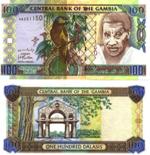 The
dalasi was adopted in 1971. It replaced the Gambian pound at a
rate of 1 pound = 5 dalasi, i.e., 1 dalasi = 0.2 pound = 4 shillings.
In 1971, coins in 1, 5, 10, 25 and 50 Bututs and 1 dalasi were
introduced. The reverse designs of the three higher denominations
were taken from the corresponding denominations of the previous
currency (1, 2 and 4 shillings), with the reverse designs for
the lower three coins coming from the 6, 1 and 3 pence coins,
respectively. The
dalasi was adopted in 1971. It replaced the Gambian pound at a
rate of 1 pound = 5 dalasi, i.e., 1 dalasi = 0.2 pound = 4 shillings.
In 1971, coins in 1, 5, 10, 25 and 50 Bututs and 1 dalasi were
introduced. The reverse designs of the three higher denominations
were taken from the corresponding denominations of the previous
currency (1, 2 and 4 shillings), with the reverse designs for
the lower three coins coming from the 6, 1 and 3 pence coins,
respectively.
Banknotes currently in circulation are 5, 10, 25, 50, and 100
Dalasis. 1 dalasi notes were issued between 1971 and 1987.
The assets and liabilities of The Gambia Currency Board were vested
in 1971, in the Central Bank Of The Gambia. That same year the
currency was decimalised on the basis of 1 Dalasi = 100 Bututs.
The coins were minted by the Royal Mint. The notes of 1, 5, 10
and 25 Dalasi denominated were printed by Bradbury Wilkinson &
Co. Ltd. With the royal effigy being replaced by the portrait
of H. E. The President of the Republic of The Gambia on both the
notes and the coin.
To commemorate the 10th anniversary of the country's independence
a new 10 Dalasi coin was introduced into general circulation in
1975.
A new 1 dalasi coins were introduced in 1987, based on the 50
pence coin of the United Kingdom.
On July 27, 2006 new banknotes were issued with similar designs
but with security upgrades in order to frustrate the attempts
of counterfeiters.
On April 16, 2009, the Central Bank issued into circulation new
D5 and D10 banknotes. The new notes bearing the signatures of
Governor Saho and First Deputy Governor Njai, are a reprint of
the current design banknotes.
The design and features of these banknotes are similar to the
current family of freshly designed banknotes introduced in 2006.
The new D5 and D10 banknotes will circulate side by side with
the current existing banknotes.
In 2015 new banknotes were issued alongside the existing ones.
New denominations were also issued which were the D20 and D200.
|


 History Page
2 | Money
History Page
2 | Money