People have inhabited the area outside of Banjul island for may millennia before the Portuguese navigators Antoniotti
Usodimare and Luiz de Cadamosto, entered the mouth of the Gambia
River in 1455 before being ejected by hostile locals. They
returned in 1456 and managed to reach
James Island further upstream.
island for may millennia before the Portuguese navigators Antoniotti
Usodimare and Luiz de Cadamosto, entered the mouth of the Gambia
River in 1455 before being ejected by hostile locals. They
returned in 1456 and managed to reach
James Island further upstream.
After the abolition of the slave trade in 1807 the British had
to find an alternative to James
Island, which was situated on the river, to better control
access to the river and enforce the Slavery Abolition Act. The
first reason was because the Americans, Portuguese, Spanish
and French continued to trade in slaves.
Secondly to protect British commercial interest in the interior
of the region.
 In
1815 Sir Charles MacCarthy (Governor-in-Chief of all the British
settlements on West Africa) gave an order to Alexander Grant,
a British officer, to sail down from the Senegalese island of
Gorée with a 75 strong detachment from the Royal African Corps,
to look into the possibility of establishing a military stronghold
in Gambia. After a tour and inspection of James Island they settled
for St. Mary's Island (then known as 'Banjulo' by the Portuguese). In
1815 Sir Charles MacCarthy (Governor-in-Chief of all the British
settlements on West Africa) gave an order to Alexander Grant,
a British officer, to sail down from the Senegalese island of
Gorée with a 75 strong detachment from the Royal African Corps,
to look into the possibility of establishing a military stronghold
in Gambia. After a tour and inspection of James Island they settled
for St. Mary's Island (then known as 'Banjulo' by the Portuguese).
On the 23rd April 1816 Captain Alexander Grant entered into a
treaty with Tomani Bojang, the (Mansa) 'King' of Kombo, for the
leasing of the island which was duly leased by the British Government
for a yearly payment of 103 iron bars, which was the equivalent
of £25 at that time. The island was re-named St. Mary's Island
(after Cape Point's St. Mary area)
and a settlement was established named Bathurst, after the then
Secretary of State for the British Colonies, Henry Bathurst.
Grant proceeded to construct an army barracks barracks which could
hold 80 soldiers & house six cannons to guard the entrance
to the Gambia River.
 Their
task however, was made extremely difficult as Bathurst was essentially
a flat land mass which was mosquito infested and susceptible
to regular flooding. By 1821 a number of official buildings were
finished which included the Barracks, a hospital, and a
court house among others. Their
task however, was made extremely difficult as Bathurst was essentially
a flat land mass which was mosquito infested and susceptible
to regular flooding. By 1821 a number of official buildings were
finished which included the Barracks, a hospital, and a
court house among others.
That same year Bathurst was put on a more formal footing when
it was incorporated and administered under the authority of the
Governor of Sierra Leone. In 1843 The Gambia became a colony with
its own Governor, judicial system, executive and legislative councils.
However, in 1866 the settlement was once again bought under the
authority of the Governor of Sierra Leone and it was not until
1888 that it reverted back to a colony in its own right.
The British Government's policy was that apart from the cost of
defence all other costs of maintaining the colony had to be derived
from customs duties on imports. In 1822 Sir Charles MacCarthy,
after his tour of the West Africa, commented about the improvement
in commerce of Bathurst being greater than any of the other posts
occupied by her Majesty's forces on the coast.
 After
3 months and a lot of effort by Grant's men and having endured
high death rates from malaria and other swamp fevers the island
soon became secure enough for it to be used as a trading stronghold
which allowed British traders to transfer their base from
Gorée Island to Bathurst. Some of
these merchants were the descendants of earlier inter-marriages
between British colonists and locals on Goree who were known as
the senioras who were Mulatto. These last people eventually owned
large estates particularly country homes in the Kombos. After
3 months and a lot of effort by Grant's men and having endured
high death rates from malaria and other swamp fevers the island
soon became secure enough for it to be used as a trading stronghold
which allowed British traders to transfer their base from
Gorée Island to Bathurst. Some of
these merchants were the descendants of earlier inter-marriages
between British colonists and locals on Goree who were known as
the senioras who were Mulatto. These last people eventually owned
large estates particularly country homes in the Kombos.
|
|
Quick Facts:
• The former name of Banjul is Bathurst.
• Named after Henry Bathurst in 1816.
• Renamed Banjul in 1973.
• Prior to 1816 known as Banjulo.
• Acquired city status in 1965.
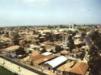 MacCarthy
Square (July 22nd Sq.), was named after Brigadier Sir Charles
MacCarthy (governor of Sierra Leone and the West African Settlements).
It was at the very centre of the cluster of Government
buildings. The first public buildings encircled the square. They
were the Government House and a six gun battery, barracks,
officers’ mess [now the Government offices in the Quadrangle],
and the Colonial Engineer’s Yard, which later became Albert
Market. MacCarthy
Square (July 22nd Sq.), was named after Brigadier Sir Charles
MacCarthy (governor of Sierra Leone and the West African Settlements).
It was at the very centre of the cluster of Government
buildings. The first public buildings encircled the square. They
were the Government House and a six gun battery, barracks,
officers’ mess [now the Government offices in the Quadrangle],
and the Colonial Engineer’s Yard, which later became Albert
Market.
In 1818 the total population of
the new settlement was around 600. By 1826 this figure had risen
to 1,800 (excluding the garrison) of which 30 were Europeans.
In the 1830s ship loads of liberated African refugees landed in
Bathurst and were transported to the Liberated African Yard. Goderich
Village was created near Oyster Creek by the Colonial Government
in 1832 to specifically assist these Liberated Africans.
By the middle of the 19th century the local population of Bathurst
was 4,000 as well as 190 colonialists.
This growth in the numbers of people was  caused
by an influx of freed slaves from Freetown, fugitives evading
justice and people from the Wolof tribe
of Gorée Island & St. Louis in
Senegal. Such was the uncontrolled migrations that Lieutenant
Governor Mackie tried to put a stop to it. His job was made difficult
by the religious wars raging in the region. Over time people from
other tribes of West Africa also
joined them enabling Bathurst to grow from a fort with a few outlying
local villages into a city within 100 years. The reason for this
growth was because the deep port allowed large ships to dock and
thus propelled Bathurst into one of West Africa's main trading
gateways, particularly entrepot trade, to other West African countries. caused
by an influx of freed slaves from Freetown, fugitives evading
justice and people from the Wolof tribe
of Gorée Island & St. Louis in
Senegal. Such was the uncontrolled migrations that Lieutenant
Governor Mackie tried to put a stop to it. His job was made difficult
by the religious wars raging in the region. Over time people from
other tribes of West Africa also
joined them enabling Bathurst to grow from a fort with a few outlying
local villages into a city within 100 years. The reason for this
growth was because the deep port allowed large ships to dock and
thus propelled Bathurst into one of West Africa's main trading
gateways, particularly entrepot trade, to other West African countries.
The settlement's local divisions was reflected by the various
people who had come to live there. Bathurst was planned and divided
into districts for specific ethnic groups. There was Soldier
Town where the pensioners from the West Indian Regiments
and Royal Africa Corps resided. There was Jolof
Town, which was largely made up of artisans and mechanics
from the people of the Wollof ethnic group. There was the poorest
sector known as Moka or Mocam Town,
which was later re-named Half-Die
after the Cholera epidemic of 1869 killed many there, was populated
by immigrant labourers from the Kombos and up-river areas. There
was also Melville Town occupied
by the Akus which had earlier been settled
by the Jolas. And finally there was Portuguese
Town which was occupied by the Mulatto descendants of mixed
African and Portuguese parentage. As the settlement grew street
names were given which were from either prominent merchants or
generals who served in the Battle of Waterloo. In recognition
of his efforts to stop the slave trade along the river a street
was named after him called Grant Street.
The settlement was declared capital of the newly established "Crown
Colony and Protectorate of The Gambia" in 1889.
The port town gained the status of a city in 1965 which
was the same year The Gambia became independent. In 1973 Bathurst
was re-named Banjul.
After a period of stagnation and decay in the 1980's the capital
saw a rapid exodus of much of the population
from Banjul and out into the Kombos creating the Greater Banjul
area. Presently old and decaying residential homes and commercial
buildings are being demolished and are being largely replaced
by new commercial warehouses and residential apartments.
 |


 History