ART
27 - Artist Collective 
 Famous Gambian Artists:
They include people who have created some original contemporary
works on canvasses, sketches, drawings and lithographs from the
likes of Momodou Ceesay, Baboucarr
Etu Ndow, Njogu
Touray, Malick Ceesay, Edrisa
Jobe, Alhajie
Bubacarr Badgie, Toyimbo,
Moulaye
Sarr, Papa Alassane Gaye as well as lesser known talents.
 Some
of them represent the Avant-garde of the current art movement
in the Gambia who use there own individual, innovative techniques
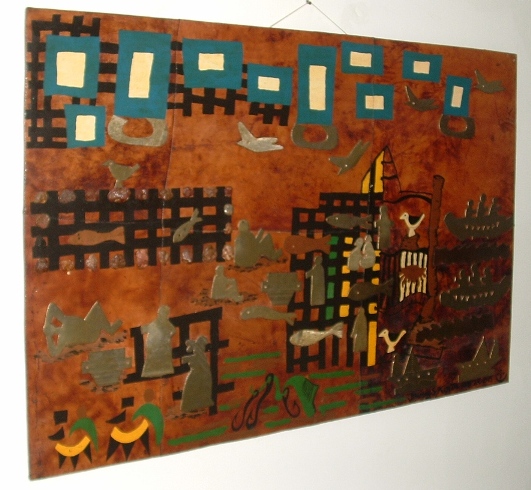
and styles. For example Etu prefers to use on his canvases objects
he finds in his natural surroundings, Modou
Ceesay prefers to work in the abstract using synthetic acrylics
and water-colours and Malick conveys stylized African figures
on canvass. Some
of them represent the Avant-garde of the current art movement
in the Gambia who use there own individual, innovative techniques
and styles. For example Etu prefers to use on his canvases objects
he finds in his natural surroundings, Modou
Ceesay prefers to work in the abstract using synthetic acrylics
and water-colours and Malick conveys stylized African figures
on canvass.
 Gambian society has laid great emphasis on the art of griot storytelling
and music but has shied away from the visual arts of paintings
whether in water colours, oil paintings or offset lithography.
However, the past few decades has seen the growing emergence of
a handful of prominent, talented and renowned local Gambian artists
as well as some who are based internationally.
Gambian society has laid great emphasis on the art of griot storytelling
and music but has shied away from the visual arts of paintings
whether in water colours, oil paintings or offset lithography.
However, the past few decades has seen the growing emergence of
a handful of prominent, talented and renowned local Gambian artists
as well as some who are based internationally.
 Among
the lesser know creative talent you can find paintings which choose
to portray and focus on subjects from local society or international
issues. However, many are aimed directly at the tourist market
which can have a un-original and formulaic feel but can be bought
at bargain prices. Keep an eye out for up-and-coming talents such
as Mustapha Jassey, Abdoulie Colley, Lamin Dibba. Among
the lesser know creative talent you can find paintings which choose
to portray and focus on subjects from local society or international
issues. However, many are aimed directly at the tourist market
which can have a un-original and formulaic feel but can be bought
at bargain prices. Keep an eye out for up-and-coming talents such
as Mustapha Jassey, Abdoulie Colley, Lamin Dibba.
Art dealers and collectors have in this century come to the conclusion
that there is none 1 monolithic Gambian school of art. Artists
of Gambian descent, just as all artists do, choose creative expressions
that reflect their individual artistic, social and intellectual
concerns. Today the country's artists explore their heritage,
their culture and art itself in a wide variety of art forms and
media. The arts market is more concerned more with the quality
of the work itself and less with the style.
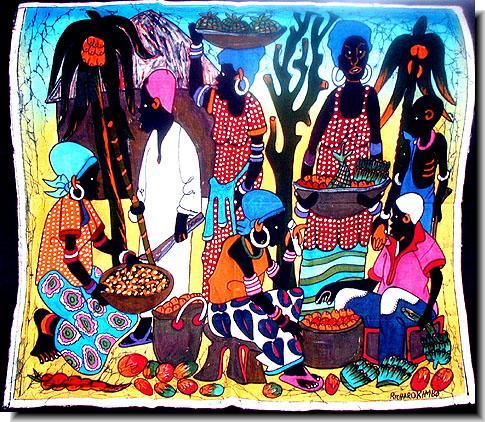
Reverse-glass painting in Gambia flourishes today as a commercial,
touristic art form, but this was not always the case. Well before
the 1960s, it was mainly a local art for local consumption. There
has been a dual move away from the earlier focus on Islamic religious
topics to more secular modern themes such as portraits, domestic
scenes and general social commentary.
Thanks to major international exhibitions in recent years Gambian
tribal artists have gained in popularity among connoisseurs.
At the beginning of the 20th century this new form was already
arousing great interest among collectors and fine artists alike;
and at a time when it was seen as the innocent cultural creations
of primitive peoples, Picasso, was already drawing inspiration
from the strikingly new qualities of form. Over the past 10 years
market globalisation and the World Wide Web have heightened the
interest of collectors and scholars in objects from West Africa.
|
|
 |


 Culture & Traditions
Arts & Crafts Art
Galleries | Musicians
Culture & Traditions
Arts & Crafts Art
Galleries | Musicians