Introduction:
 The
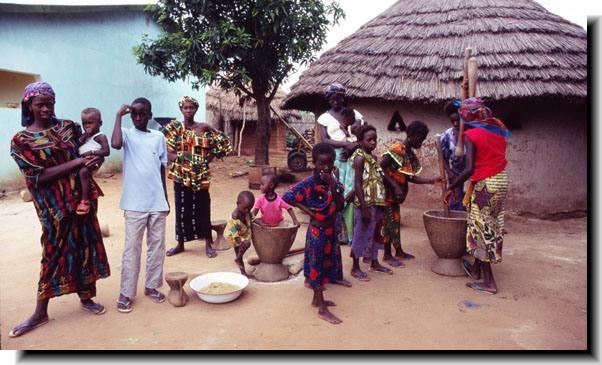
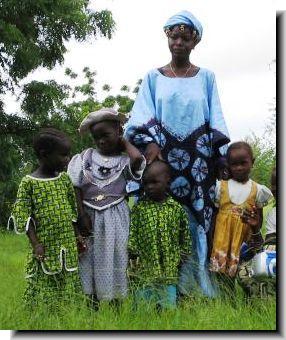
traditional extended family is the most common type of family
unit structure in The Gambia and is a unit that can help to foster
good or bad family relationships. It plays a central role in Gambian
society and it is perceived as a status symbol to support a large
family and have more than one wife. The
traditional extended family is the most common type of family
unit structure in The Gambia and is a unit that can help to foster
good or bad family relationships. It plays a central role in Gambian
society and it is perceived as a status symbol to support a large
family and have more than one wife.
Traditionally Gambian families tend to be large and three generations
may live together in one household with each having different
roles. The average household size is 8.5 members per household,
and the dependency ratio 65% (The Gambia
Bureau of Statistics, 2006) and estimated at 6 people in urban
areas and 15 people in rural areas.
Structure:
 Individuals
tend to take over as head of a Gambian household much later in
life at around 40 years old. It is not very common to find grandparents
living in their children's houses as they themselves tend to be
the head of their own family. Households have a complicated hierarchy
and are constantly changing and one of the reasons is the polygamous
nature of Muslim society. A second
wife may through default become the first wife. Where a man has
multiple wives they would pool their time and effort for the general
betterment of the household. Individuals
tend to take over as head of a Gambian household much later in
life at around 40 years old. It is not very common to find grandparents
living in their children's houses as they themselves tend to be
the head of their own family. Households have a complicated hierarchy
and are constantly changing and one of the reasons is the polygamous
nature of Muslim society. A second
wife may through default become the first wife. Where a man has
multiple wives they would pool their time and effort for the general
betterment of the household.

|
|
Hierarchy:
• Head
• Temporary Head
• Spouse
• Children
• Son's children
• Daughter's children
• Head's parents
• Brother / Sister
• Nephews
• Nieces
It's quite normal in Gambian society to call more than one person
'mother' or 'father', and often people with no apparent blood
ties are called 'relatives'. Though it should be noted that because
Gambia is so small and inter-marriage between people from different
ethnic groups so common many
people are related without even knowing it particularly in the
Greater Banjul area.
Being a patrilineal society the father is normally head of the
family though the role and responsibilities of running of the
household is left to the wife. The times when most family members
living outside the household meet at one time is usually at naming
ceremonies, funerals
and weddings. At these events different
members have different roles to play as there would be an immediate
hierarchy based on age, religious learning and status through
birth and lineage. Respect to elders is vitally important in developing
good relationships in particular greetings,
showing due respect and listening to advice.
At the lowest village level there is
the compound which would
have the eldest male as the head of the household and possible
several other families who share blood ties as well as the wives
and children, uncles, aunts and grandparents. His role is of decision
maker and resolving disputes. Then there would be other compounds,
perhaps nearby, were related family members live and the head
of this grouping is yet again the eldest male. Then finally there
is the chief or what Gambians call the Alikaalo
who is the oldest man from the founding family of the village.
This localised family make-up is fairly typical among different
groups.
There is no hard-and-fast rule to this family make-up as older
male members can choose to move out and start their own compounds
with their own wives. It can be a fluid system as it is very common
in the Kombo St. Mary District to find households with just the
father, mother and children, if they haven't already left home,
and maybe a relative who helps out in the house or keeps the wife
company. Having said this however, wealthy Serahules
in the K.S.M.D like to keep tradition alive and tend to have a
large extended family structural group staying in one building.
Many more educated women now work in The Gambia, though it was
less common among the older generation and as a result it has
altered the traditional role that wives have played.
|


 Culture & Traditions Weddings Compounds