Introduction:
 There
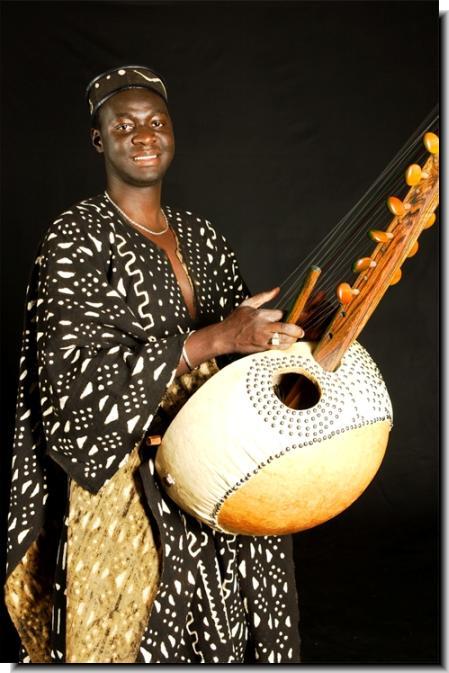
are 2 kinds of Gambian Griots in West Africa: One that sings and
another that plays the Kora (Cora) musical instrument. There
are 2 kinds of Gambian Griots in West Africa: One that sings and
another that plays the Kora (Cora) musical instrument.
The first reference to the Kora was made by Mungo Park in his
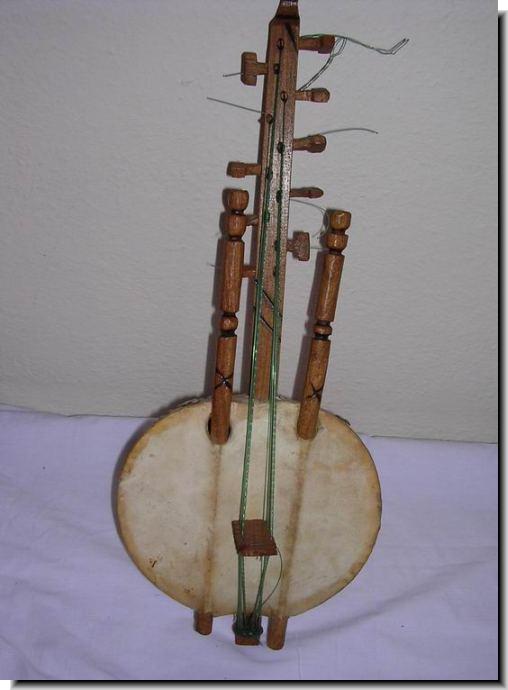
1799 book describing his trips in West Africa. It can be described
as an African harp held vertically between one's legs when played.
This is the musical instrument that has a range of over three
octaves, the enchanting music of the Kora is multi-layered and
melodic. It accompanies the Jalis (Griots pronounced gree-oh)
who are praise singers of the Mandinka
Tribe (Mande / Malinke) have a tradition going back hundreds
of years. A master griot often has no need for verbal accompaniment
and uses a technique known as birimintingo to "talk to the
Kora."
In the past, the role of the professional musician
was reserved for those born into the griot caste.
It is sometimes part of an ensemble which includes the Balafon
(a type of wood xylophone). Their unique role as praise
 singers
is passed, after a long apprenticeship, usually from father
to son though it can be passed from an uncle. It requires many
years of musical and historic training for a student to become
a master Kora player and to be able to recite the religious, ethnic
and family lineages. singers
is passed, after a long apprenticeship, usually from father
to son though it can be passed from an uncle. It requires many
years of musical and historic training for a student to become
a master Kora player and to be able to recite the religious, ethnic
and family lineages.
The Bolonbata (also known
a the kontingo by the Mandinka
and as the halam or xalam by the Wolof)
is a variation of the Kora with at most 5 strings and has a bent
neck made of Keno wood and a small gourd body resonator that is
encased in leather. This instrument is played just by the Fulanis
and Mandingo people in Gambia.
Griots have long been respected for the power of their music can
carry. Although the role of the griot has diminished with the
evolution of contemporary society and the passage of time, the
griot still remains an integral part of the culture of Gambia
and the strongest link to centuries of history.
For centuries, court musicians
and ‘griots’ (story-tellers) have kept alive tales of family
and village history, and you may find them singing their oral
accounts and stories accompanied by a ‘Kora’. This tradition gives
the Mandinka people their strong sense
of ethnic identity and history. Griots have long been respected
for the power of their music can narrate over.
They sometimes belong to the household of a nobleman, appointed
to sing the virtues of their benefactor and master. However, most
are independent, singing the praises of anyone who can pay them
and a less generous clientele might find the song more critical
than giving praise. Because of their deep knowledge of history
they are often viewed with a mixture of fear and admiration. But
the griots of Gambia continue to maintain the traditions of their
people for the generations to come.

|
|
Declining Influence:
In the l9th century the religious Soninke-Marabout Wars and colonial
influence caused the break-up of ruling noble families. The Europeans
appointed chiefs who often had no connection to the traditional
ruling houses. Thus, with prestige and power usurped by the new
chiefs and their resources drained by a French-imposed tax system,
the traditional noble patrons could no longer care for their griots.
Many griots were forced to adopt several patrons, and others became
itinerant freelance musicians. The griots' new role became more
that of an entertainer and musician and less that of a genealogist
and historian.
Background:
The role of the griot is more than just a story-teller. He or
she is a genealogists, singer, deliverer of social or diplomatic
messages, war rouser, general joke telling and buffoonery and
is highly prized at tribal celebrations. The belong in one of
the lower castes however, their musically talented role which
accompanies the oral tradition is well respected and as a result
many make a very good living from their social role. They still
exist today, although the role of the musician is no longer held
by the griots exclusively. The Gambian griot is a troubadour,
the counterpart of the medieval European minstrel. This living
archive of speech and song maintains oral traditions, both local
and epic. They are taught by their elders and are trained over
many years to learn the enormous quantity of traditional songs
and to master the melodies and rhythms. He might be required to
sing seven generations worth of a tribe's or family's history
and, in some areas, to be completely familiar with the songs of
ritual necessary to summon spirits and gain the sympathy of ancestors.
Because of the low caste
of the griot in some sections of West Africa, they have been denied
an earth burial and their remains were placed in Baobab
trees instead for fear that they would make the ground impure
and shorn or fertility. Today, such discrimination is illegal.
Famous Gambian Griots:
Some famous names include: Foday
Musa Suso, Bai Konte, Papa Susso, Amadu Bansang Jobarteh and
Doudou M’Boob. The most legendary being Balafasé Kouyate who was
the personal griot of great Mandinka leader Sundiata Keita (also
spelt Keyita).
Griots and Modern Music:
Perhaps the most important traditional function of griots seen
from the perspective of modern Gambia is their role as performing
artists. In most cases, griots were the sole musicians and storytellers.
Among the exceptions to this rule are noble Fulbe shepherd musicians,
who play the riiti (one-string violin) and the flute, as well
as noble Fulbe and Bamana hunters in Mali, who play the hunter
ngoni, a five- to six- string harp-like instrument, and sing.
Fulbe society, which is nomadic and ranges much further than any
of the other societies in Gambia, seems to have borrowed the caste
structure and possibly even the ñeeño people themselves from other
Gambian groups and can therefore be expected not to have exactly
the same musical taboos.
Still, although certain groups of non-griots traditionally practice
music, it is only recently that they have begun to move, against
vehement social resistance, into the professional music
scene. Despite certain noble non-professional musical traditions,
griots were for a long time the only professional instrumentalists,
singers, or dancers in most of Gambia, Mali, and neighbouring
areas. In Mande societies, nobles could perform musically in extremely
limited and usually ritual contexts, while in Wolof society noble
men could apparently not perform any music at all and women could
sing in only a few circumstances. Noble men believed that music
was a feminine element that would drain their powers to work the
land or fight. Griots were banned from both farming and fighting.
|


 Culture & Traditions Music Traditional | Musicians